 |
| Best? of Turkey and Grece |
Wednesday, April 27, 2011
Best of Turkey and Greece
A long time coming, dunno if anyone is actually still following the blog. Enjoy the pics.

Sunday, March 20, 2011
Athens, London, Seattle
A few quick hits on our quick tour of Athens:


The transit strike ended up being a non-issue for us. We went to our hotel and the guy at the desk told us we'd be able to take the bus to the airport instead. We asked if there are frequent metro strikes in Athens. He said no, the last one was over 2 weeks ago.
Ruins abound.
Some in decent shape, if partially restored, like this theater in the Acropolis.
On the top of the Acropolis there are so many column heads that they just stack up all over the place.
When they dug the subway in Athens, they found lots of good stuff, like tombs. One person's eternal resting spot is currently at the Syntagma subway station.
Graffiti everywhere. A lot of it is just ugly tagging:
While some is a bit more on the artful side:
Amanda and I saw about as much of Athens as we could in 24 hours. I left with the impression that it is a pretty grimy place but it certainly has character. It wasn't too hard to get off of the tourist track and have a really great dinner in a neighborhood taverna. Perhaps we'll go back someday, when the EU has made up for Greece's crippling debt by selling all of their antiquities to the highest bidder.
A few hits on London-
Heathrow Airport Terminal 4 really wants you to take the Heathrow Express into London instead of the Underground. There were no signs whatsoever for the Underground that I could find. We ended up making our way to Terminal 3 and finding it from there.
We used Hotwire to get a hotel in London and ended up staying in the Kensington neighborhood. It seemed that people celebrate St. Patricks Day to a similar extent in the US.
Our hotel was next to a showroom for Bristol Motors, a boutique auto maker of whom I'd never heard. Their cars looked to be designed in the 80s and not updated since.
We're back in Seattle now, hanging out with our friends Shelby and Ross while we settle in and find a new residence.
Wednesday, March 16, 2011
Turquoise and Aegean
From Cappadocia we took an overnight bus to Kaş. That felt about as miserable as you might imagine; Matt got a few hours of sleep, I tried to convince myself that I was enjoying the scenery as we drove through the snowy mountains. Kaş, profoundly off-season, was a good coastal retreat on the Turquoise Coast.

Surprised to see that the water was actually turquoise. Thought the name came from an abundance of turquoise (the rock) in that region.
We spent some time hiking parts of the Lycian Way, a through trail that stretches along the coast from its eastern end in Oludeniz to its western end in Antalya.

A horse we met along the trail down from Phellos.
 Lycian tombs on top of the mountain.
On our Phellos hike we had a notable encounter with a lost goat who mistook us for fellow goats. What is your responsibility when a goat approaches you, wanting to be led back to its friends and family? I should add here that we had several notable encounters with nature on the Lycian trail. Bees, turtles, caterpillars, ferocious man-eating domesticated goats and horses. It was enough to make me miss hiking amongst bears.
Another section of the trail that we walked outside of Fethiye brought us through Kaya Köyu, a Greek Orthodox Christian village that was abandoned during the post WWI population swaps. A bit sad to see the old stone buildings--there is a beautiful church that nature is slowly taking back.

We had the ghost town to ourselves, then hiked up over the hill and down to a lagoon.
The seafood in Fethiye was super. Tourist tradition is to go to the fish market and pick out some fish, then bring it to a nearby restaurant and have them cook it up for you. We liked it so much we went two nights in a row, have no idea what the fish we ate were, they were silver, little and tasty when fried.

Anchovies, maybe?
Our last stop in Turkey was at Bodrum on the Aegean where we needed to catch the ferry to the Greek Island of Kos. In Bodrum we explored St. Peter's Castle, which is also conviently the Museum of Underwater Archaeology. They have an amazing number of amphoras on display (conical ceramic containers for carrying stuff) and several great exhibits on underwater excavations of shipwrecks, including one from the Bronze Age. Amazing to see the relationships between all of the Mediterranean port cities stretching back through time.

Some of you might remember that we'd planned on spending time in Greece before our return to Seattle. Well, we liked Turkey so much that we decided to focus the end of our trip there and save Greece for another time. From the island of Kos we traveled to Athens. Here, in the face of a transit strike, we hope to make it to the airport and then head for home.
Tuesday, March 8, 2011
Adventures in the Offseason
After a bustling few days in Istanbul, Amanda and I made our way to Cappadocia via Ankara.
A couple of quick hits on the capital:
Turkey is currently working on completing the high speed rail link between Ankara and Istanbul. For now, the train runs a normal-speed train from Istanbul to Eskişehir, and from there the high speed line takes passengers on to Ankara. The high speed line really felt like the future of travel; it whisked us along comfortably at about 250 km/hr. I'm hoping the US can one day get its act together and get some good train travel.
On our way out of Ankara, we met a friendly young Istanbuler named Tichoten* who was heading home from Ankara after his mandatory military service. He helped us buy a ticket at the metro, we had a nice conversation with him on the metro, and he insisted on walking us to the right ticket counter at the bus station and even ordered our tickets for us.
*or Tichome or some other sort of common Turkish name that we didn't quite understand and we felt foolish about not remembering.

Cappadocia
On to Göreme, which was our base for exploration of Cappadocia. I hadn't heard of Cappadocia until after we had booked our tickets to Turkey so I didn't really have a lot of expectations about what we were going to see there. We've seen our share of fascinating natural formations and ancient ruins on this trip. Cappadocia more than held its own; it was a delightful time and we enjoyed being there and trekking around the various sites.
It is firmly off-season now; the town is rather empty, there's a lot of half-done road work, some restaurants are closed, and those that are open seem to have more staff than customers. Our experience in Göreme was certainly not typical of what to expect during a summer visit. Low season does have the benefit of lower stress - there aren't many lines at interesting sites, no long waits for food, no needing to make reservations weeks in advance to stay in a nice place, and places to stay are less expensive. The weather left a little to be desired, but so it goes with off season travel.

We took a nice hike up Pigeon Valley to the nearby town of Uçhisar.

Uçhisar (we learned later from a friend that the schlep up to the castle at the top was not particularly rewarding that day)

From Uçhisar, we hiked back to Göreme through Love Valley. Didn't quite figure out the name.
Earlier in the day we met Nils, a German student studying in Turkey through the Erasmus program. We met up later at the one authentic-ish Turkish meyhane in town. There we tried some rakı and watched as the patrons danced. As they got more drunk, they were a little more insistent that we join them in dancing, and finally at the end of the evening everyone was up dancing. Amanda and I pulled out some horribly rusty moves, but I think we were still better dancers than the British couple.
We had an amusing tour the next day, seeing some sites of southern Cappadocia. The weather was even worse than the previous day, but things were made much brighter by the cheery Korean and Japanese students who were on the tour with us.

We toured what appeared to be a well-established loop, but with it being cool, foggy, and occasionally rainy, we had many sites to ourselves. We also ended up seeing panoramas like this:

But then again sometimes the fog would cooperate and give us a cool perspective like this:

The Selime Cathedral
All in all, travel in Cappadocia in the off season has been pretty worthwhile.
Saturday, March 5, 2011
Istanbul Aksamleyin
 Matt says that he's not sure what to write about Istanbul even though it is his turn to write an entry. It is 8:00 in the evening in Ankara and I finished my book, the guidebook chapter on Turkish history, and every other scrap of English language writing I can get my hands on while Matt tries to finish Infinite Jest so I can start it. So this will be my entertainment for the evening.
Istanbul may be harder to write about because like any truly big city, we would have to stay put for a long time to understand what it means to live there. Since New York is my "this is what a city is" template, it's comforting to be in a big, cosmopolitan, dynamic place--felt like we were reconnected with the world. I loved the architecture and the water. This is what we learned in two days.
Great food. When we were riding into the city from the airport on the metro, Matt looked so longingly at a Turkish grandma's bagelesque sesame seed bread (Matt: I was not looking longingly at her bread, I was looking in astonishment that her bag appeared to be a bread oven.) that she broke off a piece and made us eat it. There are carts selling these breads and other snacks all over the city.
 Roasted chestnuts, pastries. Many candy stores selling Turkish Delight (gummy sweet candy, sometimes with nuts). Don't worry Seattle, we'll bring you some. (Matt: Everybody else, worry). Pastry stores selling baklava and puddings, including one kind that is made out of chicken breast.
 Tourist sites. Tourist sites in big cities are so often expensive, crowded, and more trouble than they are worth, but on a cold gray off-season day it was easy to take in some of the major sites. We checked out Topkapı Palace first where we were apparently fascinated by all of the geometric patterns because we ended up with tons of pictures of doors, windows and ceilings.

It was worth the extra fee to see the harem where the ruling class of the Ottoman Empire kept its wives, slaves, their children, and eunuchs. We also took in two religious sites, the Blue Mosque built in the 1600s, and Aya Sofya, the Byzantine Church of Divine Wisdom turned mosque turned museum.

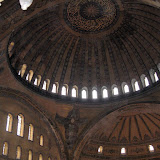
View from the upper level of Aya Sofya, a big, big religious structure. The lights are suspended down to almost the level of your head, not quite sure why because it makes it difficult to feel the size of the place. Unlike big Catholic cathedrals that make you look up?
(As a side note, this is the most expensive place to use the bathroom that we have visited yet. It often costs as much as a cup of good strong tea, 1 TL. Then again, setting the price of delicious tea low and the restroom high may be a brilliant plan for increasing revenue, take notice University of Washington.) The Grand Bazaar was another impressive place to walk around. Although we were warned that the shopkeepers would bug us to come have a look, we found that in comparison to Vietnam and Thailand, they were friendly but easygoing. Many asked "Hola, habla Español? Italiano?" We just don't look obviously American, not blond enough and too stinky.
Ferries. We took a nice ferry ride on the Bosphorus to check out the Asian side of Istanbul, which is more residential.

Matt enjoying the ferry ride, a bit chilly but clear blue water with jellyfish floating around.

Great views from the ferry, and cool to travel between continents in less than hour.
I would have liked to go on a Bosphorus Cruise and see the Prince's Islands, but the weather was not cooperating. We took a train to Ankara en route to south central Anatolia (Cappadocia). We stopped in Ankara to see the Museum of Anatolian Cultures and surprised the people of Ankara by being American tourists. Everyone was friendly, helpful, and willing to participate in our pantomime skits for buying things and finding information.
Monday, February 28, 2011
Pictures from Jordan and Israel
Our time in this part of the Middle East is drawing to a close. Here are some more pictures from our travels here.

Friday, February 25, 2011
New Jerusalem
The tourist part of the New City seems to be dominated by the Ben Yehuda shopping street, but there are also quieter places with good bars and restaurants. Although restaurants that served typical Ashkenazi food were not common, we found a friendly neighborhood restaurant--Heimeshe Essen--that served tasty and reasonably priced dinners and take-out.

From right to left: kishke, stuffed carp, sweet and sour cabbage, farfel and Jerusalem kugel (savory, no dairy).
We also enjoyed walking around the different neighborhoods, some ultra-orthodox strongholds, some secular, some historical. In the neighborhood south of the Mahane Yehuda market there are placards describing the lives of the people who lived in the old stone houses. Here's a picture of Matt wondering if he can find the hat that will allow him to pull off this look:


The weather was just about perfect so it was hard to stay inside, but on Thursday we took a great tour of the Knesset (sorry, not allowed to have pictures of that) and spent the rest of the day wandering around the Israel Museum. They have a large model of the Old City in the outdoor sculpture garden that looks so real that when birds land in it, it is disturbing.

Tourist groups admiring the Second Temple Period Old City Model.
To get out of the city for a day, we took one last trip to the Dead Sea area and went hiking at Ein Gedi to some beautiful waterfalls above Wadi Arugot. The water comes bubbling out of the rocks and trees and shrubs grow up around the stream that flows down to the sea.
 Green stuff in the desert.
This picture may not look exciting, but fresh water is bubbling up from under this rock outcrop. I'm about to slam my head into the rock trying to scramble out of there.
We're holed up in Tiberias for Shabbat at the moment and starting to plan the last leg of the trip in Turkey and Greece. Hoping all is well with everyone at home.
Tuesday, February 22, 2011
Holy cities
Tzfat (Safed/Tsfat/Zefat etc....) and Jerusalem are two of the holy cities (or horry shitties as Tuong Lu Kim of South Park might say) for Judaism, and Amanda and I visited them good.
Tzfat is the home of Kabbalah study, a subject only those learned enough in the ways of the religion can begin to embark on their path to whatever it is Kabbalah leads you to. Jerusalem, you've probably heard of that one.
Neither of these traditional spiritual places really struck me. Perhaps part of the problem in Tzfat was the sheets and sheets of rain that poured down during our visit. But I don't think I have a lot of common ground with the folks who are so taken by Tzfat that they decide to stick around. We still tried our best to have fun while we took in a couple of synagogues and art galleries; the day certainly wasn't a total loss.
The old city of Jerusalem is sort of fascinating. It's part museum, part mall, part home, and mostly nuts. This time around, the thing that struck me more than anything is the fact that historical precedence suggests that the odds of Jerusalem being blown to shit again are pretty high. So for me, it is a little hard to get attached to this piece of earth that so many people find to be holy. If anything I think I had anti-Jerusalem Syndrome.
There were certainly some touching moments in Jerusalem. Visiting the Kotel for the first time in a while is still an emotional experience. While we toured the open-air archaeological park next to the Kotel, we saw a small egalitarian bar mitzvah ceremony, which I enjoyed seeing. And after that, we saw a petrified 13 year-old boy being led towards the Kotel by a singing band of Orthodox Jews and Haredim, complete with clarinet and shofar accompaniment. The procession was tailed by curious gentile tourists snapping pictures and dancing along. While I personally have not viewed the marketing material that the foundations use to convince bar mitzvah aged children to come to Israel for their first step into adulthood, I would hazard a guess that this scene is not quite what they show. Nevertheless, it was a rather awesome sight.
This is one of the most well-trodden pieces of land on the planet, and I don't really have much to add. Enjoy our pics with snippets of commentary.
As far as Temple Mount goes, I think we might be best of selling it to China and letting them handle it. If there's one group who might be able to handle the responsibility for everyone, it's an authoritarian communist government. This could also bring up the interesting prospect of performing some archaeology on the Temple Mount.
 This is about all we saw in Tzfat. Rain.
After a wet day in Tzfat, we drove north to Agamon HaHula. The valley here was once a marshland that was a major landing spot for migratory and local birds. Israelis conquered the marshland in the early 1950s and converted it to farmland. After a while, the ecologists were successful in pointing out how completely ruinous this was, and part of the land went back to wetlands. Now, a bajillion cranes spend the winter there, amongst many other birds that call it home.


In the Muslim Quarter in Jerusalem, some of the doorways are marked by graffiti and posters. This apparently is a celebratory mark for their recent pilgrimage to Mecca.

Here's a mosaic wall in the Jewish Quarter that depicts some well known biblical scenes.
Next up, the newer part of Jerusalem.
Thursday, February 17, 2011


Wednesday, February 16, 2011
Mediterranean Israel, Yofi!
We arrived in Tel Aviv to find a beautiful sunset over the Mediterranean and a scramble to navigate one-way streets and mysterious parking signs to find a budget hostel. Most signs are in English, except the ones you really need. Matt reads Hebrew quickly and knows a few modern vocabulary words and some handy torah passages. I read Hebrew slowly, confuse some of the key letters, and recognize "please, thank you, chocolate, I, we, kosher, excuse me, and okay." Because many people in Israel speak beautiful English, we've had trouble increasing our vocabulary but no trouble at all amusing the locals with our attempts to communicate.

I thought that Tel Aviv was a lovely (yofi!) city--modern, interesting architecture, friendly people, cozy bars just waiting for hipsters to arrive. We had a great time walking down the beach to Jaffa, north to the old port, enjoying the sunshine, and trying out bars and restaurants in the different neighborhoods. On Friday morning, the Carmel Market was packed full of people buying groceries for the weekend and we elbowed our way in to a hummus place where they ignored us for a bit then said, "We'll give you something tourists like." To the left is a view of Tel Aviv from Jaffa. I know, looks like California.
We were concerned at first that things would shut down for Shabbat, but apparently this city just keeps on going. We found a great restaurant in the Yemenite Quarter--Hamitbachon. Simple and filling food, one of the most amazing desserts I've ever had. Halvah Parfait. Some variation on Halvah (sweet sesame past candy) + cream + frozen. I wish I could take some with me for everyone at home to try it.

We found ourselves in the Neve Tzedek neighborhood one evening and stumbled on the Tel Aviv brewery. Beer in Israel seems to be hit or miss, and this microbrewery was no exception. But for the sake of Matt's happiness, I was glad to see that the idea of good local beer is on peoples' minds, and there's room to grow. Reminds us what a special place the Pacific Northwest is. And that it takes some practice in creative nonfiction writing to avoid ending sentences with "is."

From Tel Aviv, we took the train up to Haifa. I have a childhood friend there who I wanted to visit and we were curious to see Haifa. Lonely Planet makes it sound like Utopia. My friend Dorit and her family lived in New York for a year when we were both in the 7th grade, which makes it almost 20 years since we've seen each other (though we quickly discovered that neither of us has changed much since we were 12--not sure exactly what that means about us). Despite having almost no idea what kind of person I'd turned into other than clues from Facebook, Dorit and her husband Eran offered to put us up and happily showed us around their part of the world. Haifa is one of the most livable places I've been, and the surrounding area was also beautiful. We went on a hike on Mt. Carmel through rocky hills, cow pastures, ancient stone foundations, F-16s flying overhead, and meadows of irit and calenit flowers.

View from Mt. Carmel over olive tree farms.

Eran, Dorit, Amanda and Matt--Valentines Day double date (by accident--surprised to see that Israeli restaurants and businesses are pushing that) at an Irish Pub in downtown Haifa.
Saturday, February 12, 2011
Whereupon We are mistaken for Modern Orthodox
We're back in a fully Westernized country, with all of the pros and cons associated with such a place. After spending a few weeks in countries where meeting our day-to-day needs sometimes felt like a struggle, traveling in Israel is both refreshing and also kind of too easy. Yesterday, we had a few tasks we were hoping to take care of, and we were able to complete them all within a few hours while walking around Tel Aviv, and still have the entire afternoon to walk around new neighborhoods, see the sunset, go out for dinner, etc. Now, it almost feels as though we are just toodling about in an alternate USA; somehow the little things seem slightly less remarkable.
Amanda and I walked into Israel from Jordan across the Yitzhak Rabin crossing to Eilat, where we rented a car and started making our way up north to Tel Aviv. Along the way, we stopped at Timna Park, which has an array of fascinating geological formations, ancient art on desert walls, 6000 year old copper mines, and an artificial lake. It sort of reminded us of Wadi Rum had it been done American style.

Amanda climbs in the copper mines
From Timna we made our way to Mitzpe Ramon, a town in the middle of the Negev on the edge of the Maktesh Ramon. The maktesh is a giant crater that was formed by erosion; to us it seemed more of an abrupt ridgeline than crater but that certainly didn't take away from the cool desert hiking within. Upon arrival in Mitzpe Ramon, we found a surly, empty hostel offering us a room for well over $100, and a nice but also empty hotel for more than that. Hoping to not spend more than $100/night, we remembered reading something about being able to stay on an alpaca farm outside of town. With our trusty rental car Shittim, we found the alpaca farm and secured a more affordable place to stay. It ended up being pretty nice digs; they have small cabins for rent that are spitting distance from the alpacas.

Matt admires the white rocks in Maktesh Ramon

Amanda admires the residents of the alpaca farm
After the alpaca farm and a day of hiking in the crater, we headed down to Ein Gedi on the Dead Sea where we basically had no good options for accomodations and stayed at the overpriced Ein Gedi Kibbutz. At least this allowed us to easily see Masada and the Dead Sea the next day. On the way out of the kibbutz to Masada, a nice woman from Ukraine/Minnesota/Sweden asked us to give her a ride over to the hostel, and we chatted with her. We hadn't showered or changed our clothes in a little bit, so we were covering our hair. She mistook us for modern Orthodox Jews trying to decide to make aliyah. You can judge for yourself if you think we look like that.

Is this the face of Modern Orthodox?
We decided to spring for the Masada Museum, which was worthwhile but a bit strange. Those of you with further interest in museumology will get a fuller explanation when we return (in short, 3-D is not always the best medium for explanation).
On my Taglit trip to Masada, we were roused from an unrestful sleep at a Bedoiun camp to make the pre-dawn march up to the top without much background on what was really up there; even after seeing it once I had little appreciation for how developed the mountaintop was in its day. This time around, Amanda and I forewent the sunrise experience and instead hiked up mid-morning. We had a chance to explore most all of the ruins at the top, and I felt like I had a much more enjoyable and complete experience.
After taking in Masada, we hit a new low at the Dead Sea.

Trust us, this was the best picture of us at the Dead Sea
Post float, we drove to Tel Aviv during rush hour. Maybe it was a light traffic day, but I did not find the traffic to be overwhelming or the drivers to be really batshit insane. The one really annoying habit of the locals is that they will lay on the horn the second a light turns green. We've been able to wait thousands of years to return to the holy land, but you are sitting on a green light for 0.2 seconds longer than necessary...
More on Tel Aviv to come.
Monday, February 7, 2011
Welcome to Jordan, You are Welcome
 I'm sorry to condense the past week of travel in Jordan into one blog entry--internet access was a bit difficult--and I won't be able to do justice to the place. We started off in Amman, a busy city that seems designed for hot summers. Most people were glued to their televisions watching what was going on in Egypt. Those in the hospitality industry assured us, "Jordan is safe. We love our king. He already made the changes in the government we needed. He is like our God." But people were obviously inspired, empathetic, and on edge. Travelers at our hotel gathered around BBC in the evenings to see what was going on. BBC in Jordan has weird commercials.
Amman was one of those places where it is hard to warm up in the winter until they start feeding you massive amounts of rice and meat. This picture on the left shows a dish called mensaf. I like most desserts but loved the sweets, variations on baklava, some with shredded wheat, some with cheese, another that was sort of cornmeal dumplings soaked in honey. As far as we could tell, they didn't have different names for the different sweets, and thought we were strange for asking.


We spent a great day visiting Roman ruins in Jerash and Umm Qais, and the Ajlun Castle Islamic ruins in NW Jordan. Those arches really hold up.

Hadrian's Arch at Jerash
Next stop was Wadi Musa and Petra. I expected Petra to be cool but figured it was a big tourist trap and the crowds and cheese factor might take away from the experience. But it turned out to be an easy place to get lost and escape from donkey and camel rides and kiddos wanting to sell ugly jewelry. Petra was more than cool, often I could barely believe what I was seeing. The natural geological phenomena alone were incredible, and the Nabataean sandstone monuments seemed to be growing right out of the rocks. As with Angkor Wat, millions of years of archaeology grad school did not give me much of an enlightened perspective on this site, but I was grateful to have had the chance to experience Petra.
The Monastery at Petra
From Wadi Musa we traveled to Wadi Rum (Valley of the Moon) and had a 4 x 4 tour of the desert there. Wadi Rum is a protected area and you need a guide to take a camel ride, 4 x 4 tour, or backpacking trip there. Some similarities to the North American Great Basin--juniper trees, something that looked like rabbitbrush, and the Bedouin make sage tea though I didn't notice any growing there. Sandstone and granite rock formations--in some places, the sandstone looks like it is being melted by the wind.
We're on a natural bridge, not looking down.
Melty rock.
The last place we visited in Jordan was Aqaba--an easygoing seaside town where you can drink coffee, eat fish, and watch families enjoying their vacations. Our hotel room had a view out over the Red Sea to Eilat, Israel.
Matt here - If you are only going to learn one bit of English, you'd be hard pressed to come up with a better piece of language to master than "Welcome to Jordan, you are welcome!" Ok, maybe "Welcome to Jordan, where there is as much free beer as you want!" but you get the picture.
Subscribe to:
Comments (Atom)